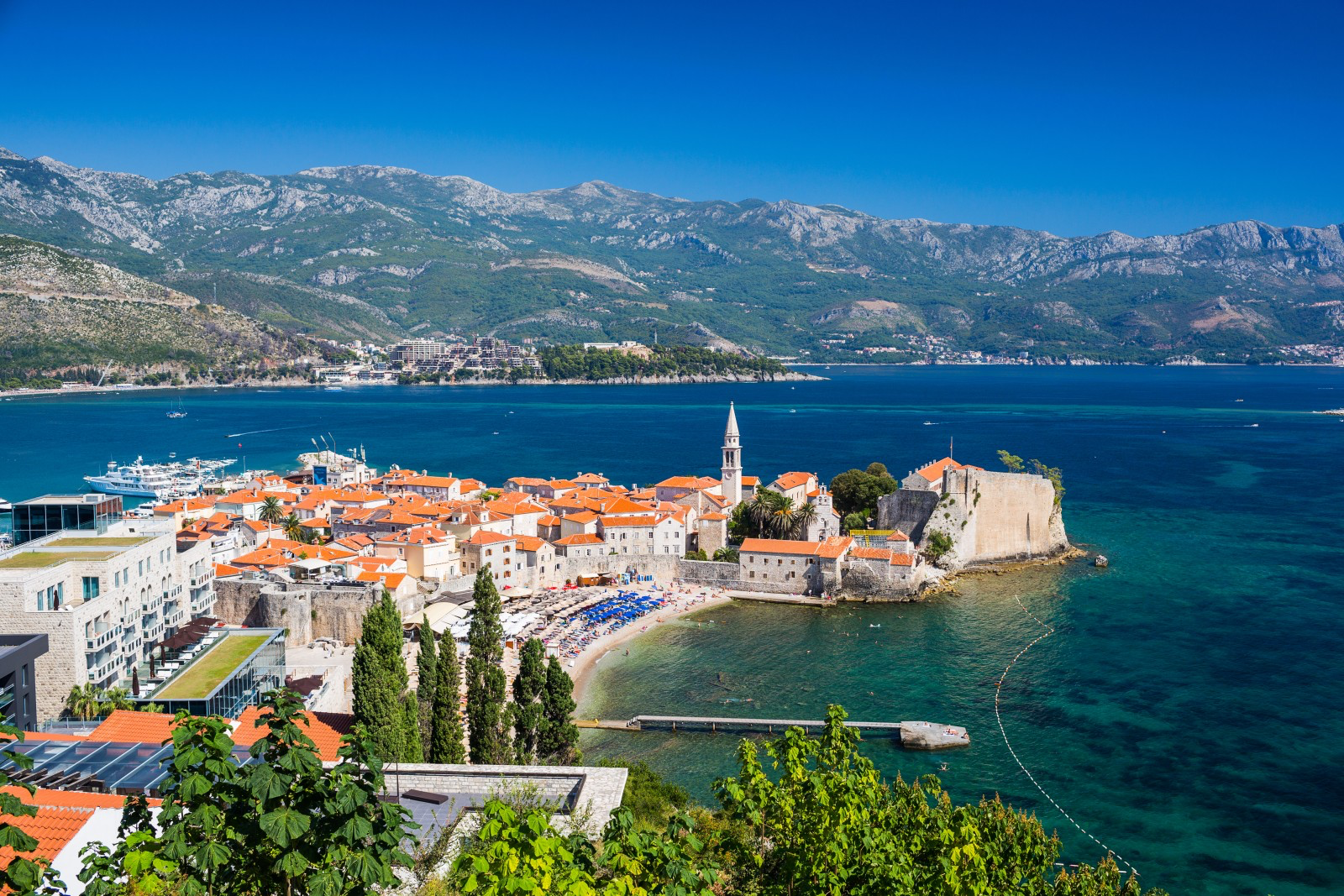
A walled Old Town, crystal-clear beaches, and a coastline that stretches toward some of the most dramatic scenery in the Balkans — Budva is Montenegro's most visited destination for good reason.
Few towns on the Adriatic coast carry as much history as they do beach umbrellas. Budva is one of them. Founded by ancient Greek settlers over 2,500 years ago, it has been shaped by Illyrians, Romans, Byzantines, and Venetians — each leaving something behind in the stone, the architecture, and the layout of the streets. Today it is Montenegro's busiest tourist destination, and yet the Old Town still manages to feel like a place where people actually live, not just a backdrop for photographs.
The Old Town
The medieval Old Town sits on a small rocky peninsula enclosed by Venetian walls, connected to the modern city but separate from it in every way that matters. Inside, the streets are narrow, uneven, and largely traffic-free. The Cathedral of Saint John dates to the 9th century and anchors the southern end of the peninsula. The citadel, built and rebuilt over centuries of changing rulers, offers some of the best views on the coast — the terracotta rooftops in the foreground, the open sea beyond. In the evenings, when the day crowds thin out, the Old Town becomes one of those rare places that genuinely rewards wandering without a plan.
Beaches
Budva's beaches range from the central Slovenska Plaža — long, busy, and well-serviced — to the more tucked-away Mogren Beach, reached via a short coastal path and a tunnel cut through the cliffs. Mogren is split into two coves and sits just below the Old Town walls, making it one of the most scenic swimming spots in the country. Further south, the road to Sveti Stefan passes a series of smaller bays and pebble beaches that are significantly quieter during peak season.
Sveti Stefan and the Riviera
A few kilometers south of Budva, the islet of Sveti Stefan is one of the defining images of Montenegro — a cluster of medieval stone houses on a small island, connected to the mainland by a narrow causeway. The island itself is occupied by a luxury resort, but the view from the road above and the public beaches on either side of the causeway are freely accessible and worth the short drive.
Nightlife and Summer Season
From June through August, Budva shifts gears considerably. The stretch of coast between the Old Town and Slovenska Plaža hosts beach clubs, open-air bars, and nightclubs that operate until sunrise. It is one of the liveliest summer scenes on the eastern Adriatic and draws a young, international crowd. If that is not your preference, the shoulder seasons — May, early June, and September — offer the same coastline and the same historic core without the noise and the crowds.
Getting Around
Budva is compact enough to explore entirely on foot. The closest international airport is Tivat, roughly 25 kilometers away, with Podgorica Airport as an alternative about 65 kilometers inland. From Budva, day trips to Kotor, Lake Skadar, the Bay of Kotor, and the mountain town of Cetinje are all straightforward by car or organized tour.
Getting there
From Podgorica Airport
65 km
from €65 by sedan
From Tivat Airport
30 km
from €45 by sedan